Discover Khevsureti: A Guide to Georgia’s Mystical Mountain Fortress
The Ultimate Guide to Khevsureti: Georgia’s Untamed Highland Frontier
Deep in the northeast of Georgia, the Great Caucasus Range splits the earth into two worlds: Piraketa (Southern) and Pirikita (Northern) Khevsureti. This is not just a destination; it is a living fortress. Known for its vertical landscapes and defiant history, Khevsureti remains one of the most challenging—yet rewarding—regions to explore in the Caucasus.
The Landscape: A Land of Two Climates
The geographical divide of the main ridge creates a dramatic shift in environment.
-
Piraketa Khevsureti: Sitting between 650 and 2,000 meters, the southern part enjoys a milder climate where autumns are golden and sunny.
-
Pirikita Khevsureti: This is the high-alpine zone, reaching up to 4,500 meters. Here, the climate is much harsher; summers are fleeting and cool ($+10\text{°C}$ to $+14\text{°C}$), while winters are brutal, with temperatures plummeting between $-12\text{°C}$ and $-18\text{°C}$.
For 4 to 5 months of the year, a thick blanket of snow cuts this region off from the rest of the world, preserving its ancient mystique.
A Warrior Legacy & Cultural Identity
Historically, the Khevsurs were the elite border guards of the Mtskheta-Mtianeti region. They were renowned for their unique steel-working techniques and elaborate military equipment. Even today, the Khevsur identity is defined by a fierce adherence to custom.
Their spirituality is a fascinating hybrid: while deeply Christian, their rituals are heavily infused with pre-Christian paganism. Though the 1950s saw a forced relocation of many villagers to the lowlands—a move that nearly silenced these valleys—the rise of eco-tourism in hubs like Shatili is slowly breathing life back into these ancestral stones.
Must-See Historical & Natural Landmarks
1. Datvisjvari Pass
Standing at 2,676 meters, this pass is the physical boundary between the two halves of the region. For centuries, it was a vital trade artery to the North Caucasus. Today, it offers some of the most breathtaking panoramas in Georgia, though drivers must be wary—visibility can vanish in seconds due to heavy mountain fog.
2. The Abudelauri Lakes
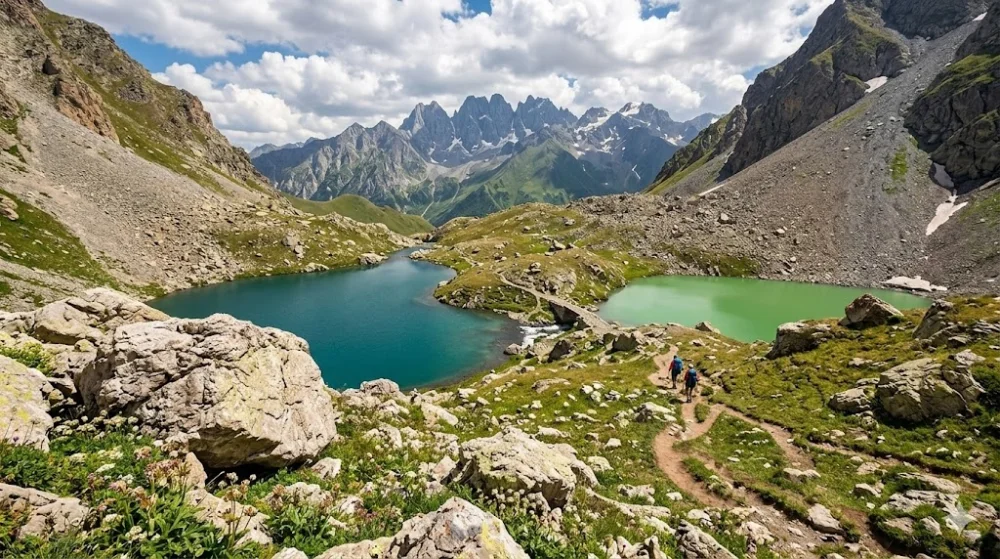
Located at 2,600 meters, these three "colored" lakes are a hiker's dream.
-
The Blue and Green Lakes: Easily accessible via a 7 km trek from the village of Roshka.
-
The White Lake: Tucked away at the base of the jagged Chaukhi Mountain, this lake is a more demanding trek reserved for experienced hikers.
3. The "Terraced" Village of Kistani
Kistani is a marvel of medieval engineering. Built on a steep slope, the village used a "terraced" design where the flat roof of one house served as the balcony for the house above it. Its outer walls doubled as a defensive perimeter, creating a seamless blend of residential life and military fortification.
4. The Citadels: Lebaiskari, Mutso, and Shatili
-
Lebaiskari: A 16th-century sentinel on the road to Shatili, this tower is a perfect example of Khevsur defensive architecture.
-
Mutso: A "city of towers" perched on a vertical cliff. Once home to 40 terraced residences and the legendary Tower of Torghva, it has recently undergone extensive restoration.
-
Shatili: A fortress-village comprising 60 interconnected towers. It is a masterpiece of mountain urbanism and currently sits on the UNESCO World Heritage Tentative List.
5. The Anatori Crypts
Near Shatili lies a somber archaeological site. These stone structures contain mummified remains from the 11th–15th centuries. Local legend tells of a plague so severe that the infected would voluntarily walk to these crypts to isolate themselves and die, sparing the rest of the village from the "black death."
The Flavors of Khevsureti
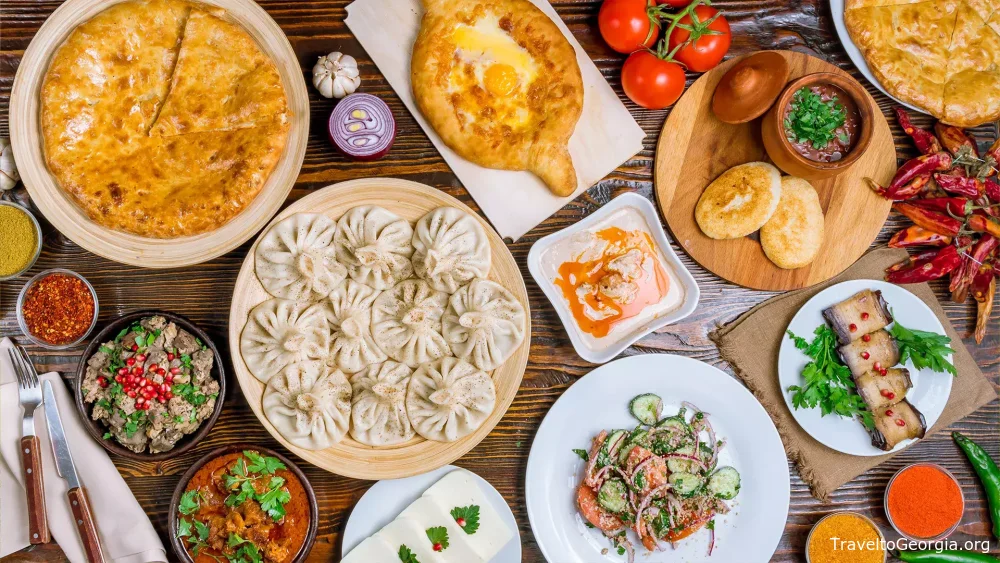
Khevsur cuisine is built for survival and strength. Notably, the Khevsurs do not eat pork.
-
Khevsur Khinkali: These dumplings are stuffed with a hearty blend of beef and lamb.
-
Khavitsi & Kuserbo: Rich dishes centered on clarified butter, flour, and melted cheese—pure "mountain fuel."
-
Dambalkhacho: A rare, moldy cheese that is highly prized for its intense flavor.
-
Mountain Beer: Brewed from barley or wheat and infused with wild herbs, this traditional beer is double-filtered for a unique, aromatic finish.
Planning Your Journey: How to Get There
Getting to Khevsureti requires patience and a sturdy vehicle.
-
Public Transport: The "Tbilisi-Shatili" marshrutka leaves from Didube Station twice weekly (Wednesdays and Saturdays at 10:00 AM). The return trip to Tbilisi is on Thursdays and Sundays at 12:00 PM. Expect a 5-hour journey.
-
By Car: Follow the Mtskheta-Stepantsminda highway, turn at the Zhinvali Reservoir, and head toward Barisakho. A 4x4 vehicle is essential for navigating the mountain roads.
Comments