Ali and Nino – A Symbol of Timeless Love
The Legend of Ali and Nino – A Timeless Symbol of Love in Batumi
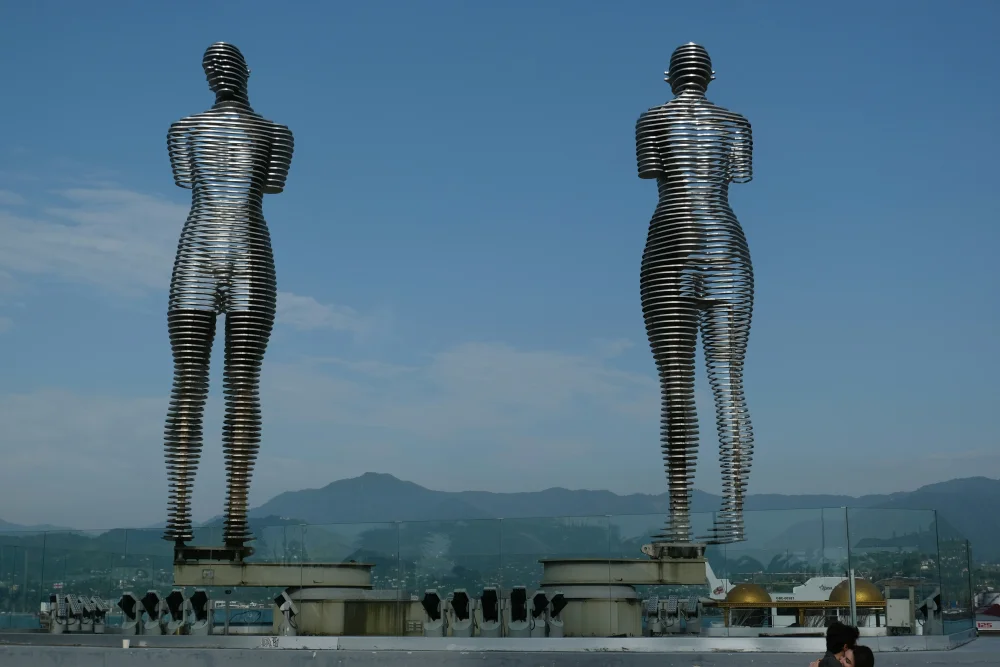
On the Black Sea coast of Georgia, in the heart of Batumi Boulevard, stands one of the most captivating and emotional sculptures in the world — the Ali & Nino Statue, often referred to as The Statue of Love. Every evening, beginning at 7 p.m., the 8-meter-high figures of a man and a woman begin a mesmerizing dance of movement. Slowly, they glide in circles, drawing closer with each turn, until they merge into one body. Moments later, they part again, only to repeat the motion every ten minutes. This graceful and rhythmic choreography symbolizes an eternal story of love, separation, and the passage of time.
The moving sculpture was created by Tamar Kvesitadze, a talented Georgian artist and sculptor known for her ability to blend modern design with profound emotional meaning. Installed in 2010, the sculpture has become an iconic landmark in Batumi and one of the most photographed attractions on Georgia’s Black Sea coast. Yet, behind its mechanical grace lies a deeply moving story — a love legend that transcends religion, culture, and nationality.
The Story Behind the Statue
The inspiration for the statue comes from the 1937 novel Ali and Nino by the mysterious author Kurban Said. The novel tells the story of Ali Shirvanshir, a young Azerbaijani Muslim nobleman, and Nino Kipiani, a Christian Georgian princess. Despite coming from different religious and cultural backgrounds, the two fall deeply in love. Their romance unfolds against the backdrop of the early 20th century — a turbulent time marked by the fall of the Russian Empire, the rise of nationalism, and the chaos of World War I.
Ali and Nino’s love is pure and passionate, but it faces enormous challenges. Their relationship is tested by societal norms, family expectations, and political conflict. In the end, tragedy strikes — Ali dies defending his homeland, and Nino is left to grieve the love she lost. The story’s heartbreak and beauty have led many to call it the “Caucasian Romeo and Juliet.” While some believe the tale is based on true events, most literary scholars consider it a powerful work of fiction — a poetic reflection of love’s endurance and fragility.
Art in Motion: The Symbolism of the Sculpture
Tamar Kvesitadze’s Ali & Nino brings this legendary love story to life through motion and form. Made from thin, interlocking sheets of steel, the two figures represent the physical and emotional distance between the lovers. As they move closer and merge, they briefly become one — a metaphor for unity and eternal love. But as the figures separate again, viewers are reminded of the inevitability of loss and separation.
The sculpture’s motion is not merely mechanical; it’s deeply emotional. The gentle merging and parting of the figures convey the universal experience of love — the joy of connection and the pain of distance. When seen against the setting sun or the shimmering lights of the Black Sea at night, the figures seem almost alive, glowing with emotion and energy.
Kvesitadze’s creation is more than a tribute to a literary couple; it’s also a symbol of harmony between cultures. The relationship between Ali and Nino — a Muslim man and a Christian woman — represents the coexistence of diverse peoples in the Caucasus region. In that sense, the sculpture stands not only as a monument to love but also as a message of peace, tolerance, and unity.
A Must-See Attraction in Batumi
For visitors to Batumi, witnessing the Ali & Nino Statue in motion is an unforgettable experience. Located on the Batumi Boulevard, near the seaside and the Ferris wheel, the statue is one of the most popular spots for tourists and locals alike. Many people gather each evening to watch the figures move under the colorful lights of the city. The scene becomes even more magical as the sky darkens and the sculpture is illuminated, creating a romantic atmosphere perfect for couples and dreamers.
The statue has become a symbol of Batumi itself, representing the city’s modern, artistic, and multicultural spirit. Whether you’re walking along the boulevard, sipping coffee nearby, or capturing photos of the moving figures, it’s impossible not to feel the emotional pull of the story behind them.
A Timeless Message
When the figures of Ali and Nino separate, it becomes clear that the individual parts of a whole can never be perfect on their own. Their movement tells us that love, while fleeting, leaves a lasting mark — just as their story continues to touch hearts across generations. The sculpture’s rhythmic motion reminds us that love transcends borders, languages, and beliefs, binding people together in ways that words cannot express.
Through her work, Tamar Kvesitadze has created more than just a piece of art. She has built a living monument — one that speaks to the eternal nature of love and the beauty of cultural coexistence. Whether you view it as a modern engineering marvel, a romantic symbol, or a cultural statement, the Ali & Nino Statue in Batumi captures something universal: the longing of the human heart to connect, even when separation seems inevitable.
So, when you visit Batumi, take a moment to stand by the seaside and watch Ali and Nino move. In their graceful dance, you’ll find not only a story of love and loss — but also a reflection of life itself.



Comments