Traditional Dances of Georgia
Georgian Dance Before the Common Era
The origins of Georgian folk choreography trace back thousands of years and are confirmed by ancient literary records, many of which are preserved in the National Museum of Georgia.
One of the most remarkable archaeological finds from the late Bronze Age is a 3,700-year-old silver bowl unearthed in Trialeti, decorated with images of masked hunters standing in a row. This artifact, now housed in the National Museum of Georgia, highlights the early cultural link between ritual and movement.
Evidence of dance as an art form also appears in the decorative figures on clay vessels discovered at the Imiri and Arukhlo settlements in Kvemo Kartli, dating back to the 6th–5th millennium BCE. These discoveries show that Georgians already practiced a form of visual performance, including dance, more than 6,000 years ago.
Among the earliest dances was the ritual perkhuli, which is believed to be the foundation of Georgian folk choreography. It remains one of the most beloved traditional dances even today.
Why Is Georgian Dance Admired Worldwide?
Every Georgian dance tells a story—whether of love, loyalty, bravery, or friendship—through expressive movements, symbolic gestures, and traditional costumes.
Each region of Georgia developed its own dance style, with unique choreography, steps, and accompanying instruments such as drums, accordions, and bagpipes.
Several of these dances have been officially recognized as part of Georgia’s Intangible Cultural Heritage, including perkhuli, khorumi, the Ajarian gandagana, and kartuli.
Kartuli – The Couple’s Dance
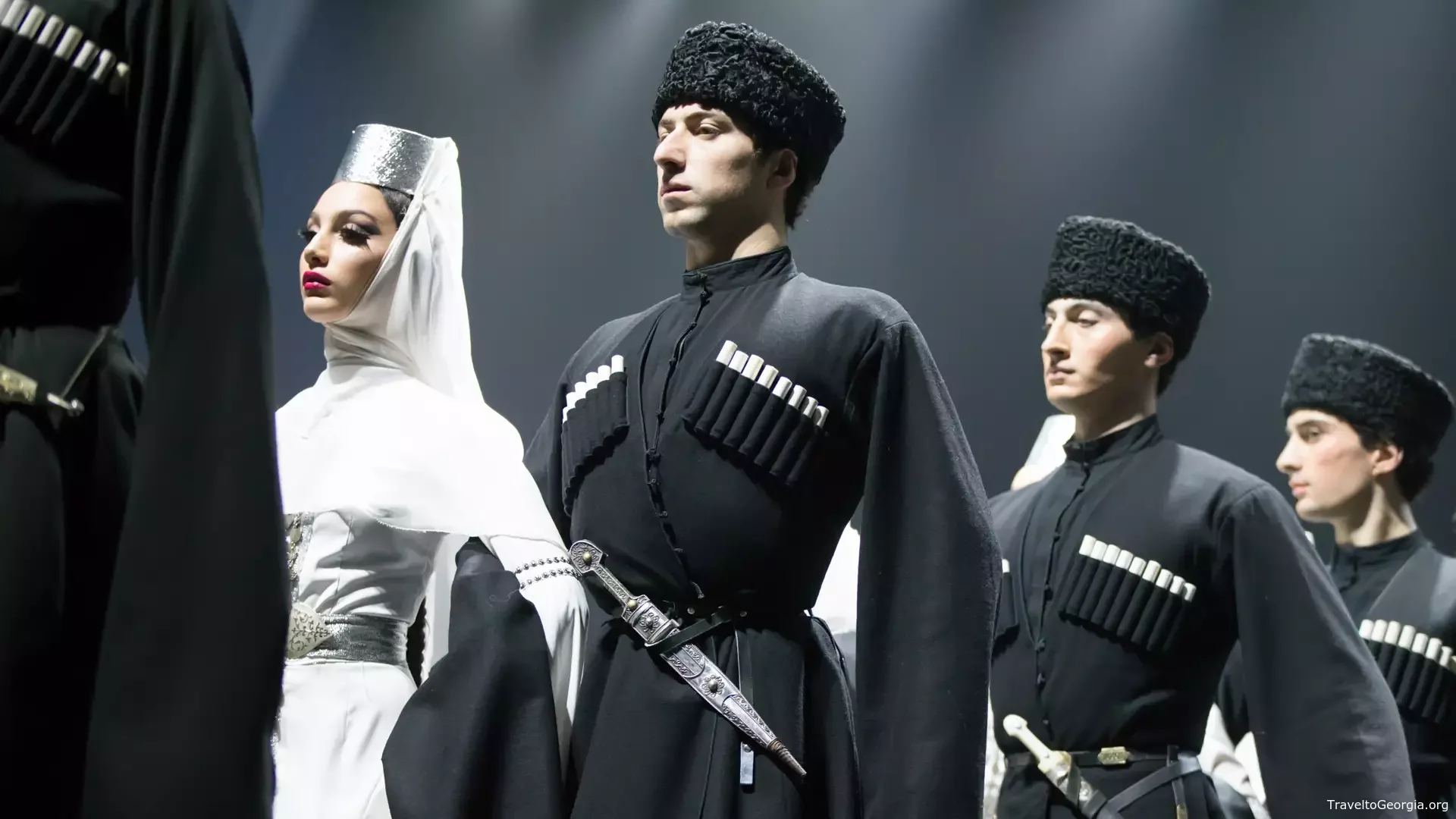
Often considered the crown jewel of Georgian dance, kartuli is the most ancient couple’s performance, dating back to the 11th–12th centuries. Unlike regional dances, it represents the entire nation.
In kartuli, the woman moves gracefully, compared to the elegance of a swan, while the man demonstrates mastery through controlled steps without moving his upper body, a technique known as gasma.
The dance symbolizes respect, restraint, and the beauty of love. Strict traditions guide the performance:
-
The man must never touch the woman or her clothing.
-
The woman begins the dance, and she leads its flow.
-
The man watches her attentively throughout.
-
He cannot leave before she finishes.
-
The dance ends when the woman bows, and the man responds in kind.
Perkhuli
Perkhuli is one of the oldest Georgian dances performed in a circle with singing, open to all participants regardless of gender or number. Its enduring spirit is reflected in the Georgian saying “perkhulshia chabmuli”—to take part in something joyful together.
One famous version, the Gurian partsa, gained international recognition in 1969 when the Sukhishvili Ensemble performed it at La Scala in Milan—the first time a folklore troupe appeared on that legendary stage.
Khorumi – The Dance of War
Originating in Adjara, khorumi is a bold and heroic war dance. Often performed by large groups—sometimes fifty men at once—it embodies unity, strength, and the spirit of battle. Only men traditionally perform khorumi.
Parikaoba – A Warrior’s Duel
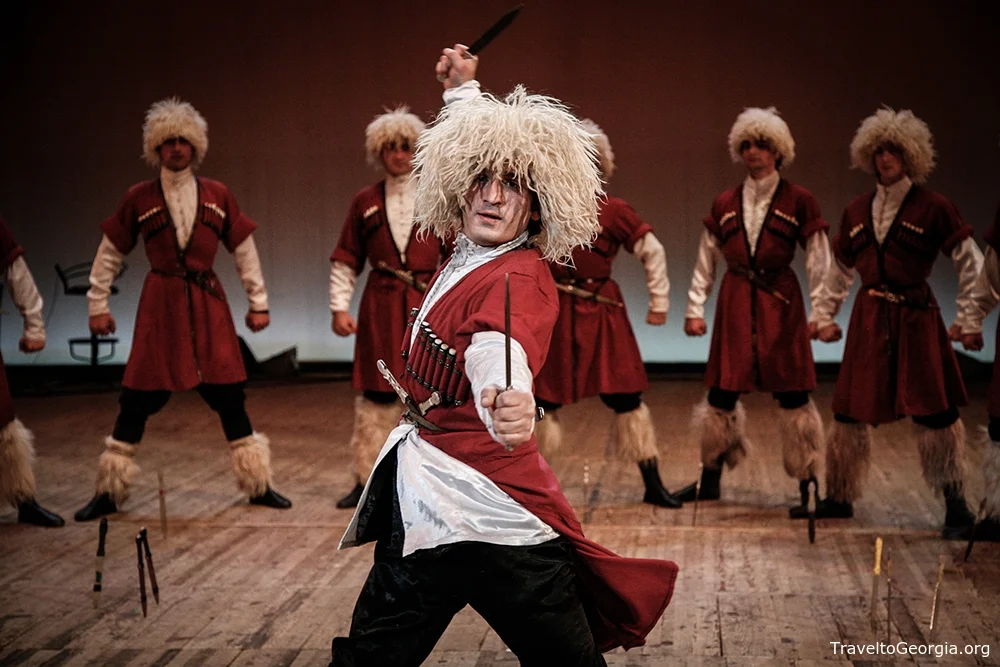
Another warlike dance, parikaoba, incorporates elements of battle and romance. The “Khevsuruli parikaoba” features staged fights with real swords, dramatic cries, and acrobatic choreography timed with incredible precision.
Ajarian Gandagana
This joyful dance from Adjara blends the strength of men’s movements with the lightness and playful elegance of women’s steps. It is a vivid expression of harmony between energy and grace.
Osuri
Known for its dignified beauty, osuri is performed in a straight line, symbolizing discipline and unity. The dancers move in complete synchrony, with the men standing beside the women like protective shields, reflecting deep respect.
Georgian Dance on the Big Screen
Georgian dance even made its way into Hollywood. In Matthew Vaughn’s 2022 film The King’s Man, elements of mtiuluri, parikaoba, and kazbeguri were used in a fight scene choreographed by a Georgian artist. The performance won the Taurus World Stunt Award for Best Fight Scene, showcasing Georgian dance artistry to a global audience.



Comments