The Uniqueness of the Georgian Alphabet
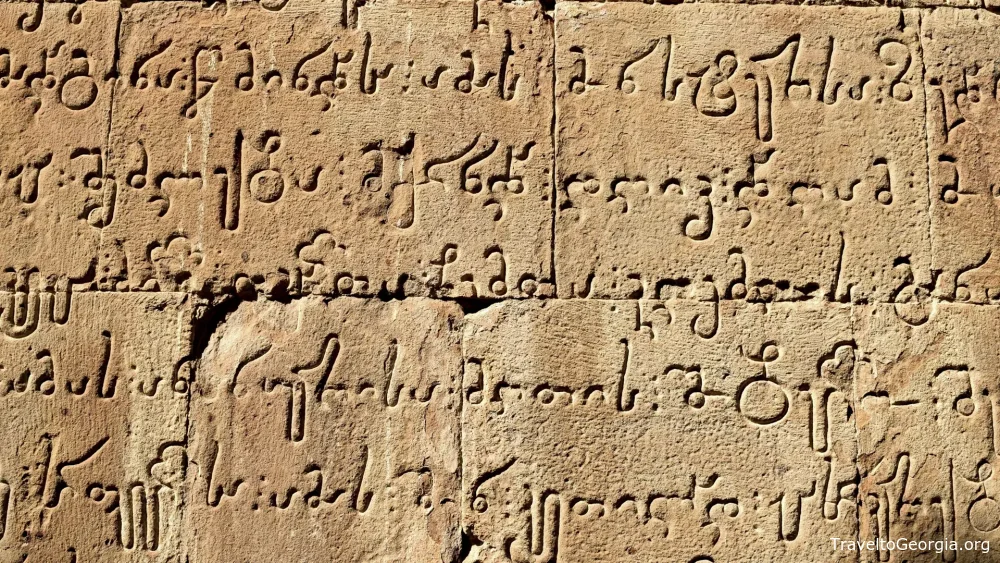
The Georgian Alphabet – One of the World’s Oldest Writing Systems
The Georgian alphabet is among the most ancient writing systems still in use today, notable for its three distinct forms that evolved over centuries. These are: Asomtavruli, Nuskhuri, and Mkhedruli—each with unique graphic characteristics shaped by historical and cultural transformations.
Early Written Sources
The earliest preserved Georgian inscriptions date back to the 5th century. The Bolnisi Sioni Church bears an inscription from 493–494, long considered the oldest example of Georgian writing. However, discoveries in the Judean Desert in the 1950s changed that view. Italian archaeologist Virgilio Corbo unearthed the remains of a Georgian monastery near Bethlehem, with inscriptions dating to 428–432.
Later, at the abandoned city of Nekresi in Kakheti, archaeologists uncovered even earlier inscriptions, suggesting that Georgian writing may have originated before the 5th century.
Scientific Debates on Origins
Scholars continue to debate the true beginnings of the Georgian script. Some researchers, including historian Ivane Javakhishvili, believed that the Georgian alphabet was created in pre-Christian, pagan times. Ancient Greek and Roman authors such as Oribasius and Apollonius of Rhodes also noted that the Colchians (ancient Georgians) had their own system of writing.
Professor Ramaz Pataridze argued that Asomtavruli, the earliest Georgian script, may have been influenced by the Phoenician alphabet and created by pagan priests around the 5th century BCE.
The Three Stages of the Georgian Alphabet
-
Asomtavruli (Mrglovani) – The oldest script, distinguished by its rounded shapes. Inscriptions such as the Davati Stela (367), the Bakur and Griormizd inscription in Palestine (433), and the Bolnisi Sioni Church inscription (493–494) are early examples. Many manuscripts from the 5th–6th centuries also used Asomtavruli.
-
Nuskhuri (Kutkhovani) – Emerging in the 9th century, Nuskhuri was a transformation of Asomtavruli. It became the main script for ecclesiastical texts and was often paired with Asomtavruli in a system known as Khutsuri (priestly script).
-
Mkhedruli – Introduced around the 10th century, Mkhedruli gradually replaced Nuskhuri. The first known Mkhedruli inscription comes from Ateni Sioni (982–986). For the past millennium, Mkhedruli has been the standard Georgian script and remains in use today.
Special Features of the Georgian Alphabet
-
Each letter corresponds to a single sound, and words are pronounced exactly as they are written.
-
In the 19th century, Ilia Chavchavadze and other reformers removed five obsolete letters that had fallen out of use, though they still appear in some Kartvelian dialects (such as Svan, Khevsurian, and Pshavian).
-
The first Unicode standard for Georgian was introduced in 1991, thanks to the work of scholars like Jost Gippert and Michael Everson, ensuring digital preservation of the script.
Recognition by UNESCO
The Georgian alphabet is not only a writing system but also a cultural identity marker. In 2016, UNESCO inscribed the “Living Culture of Three Writing Systems of the Georgian Alphabet” on the list of Intangible Cultural Heritage of Humanity, recognizing its importance and uniqueness in world history.



Comments