Svetitskhoveli Cathedral: The Sacred Heart of Georgia’s History and Legends
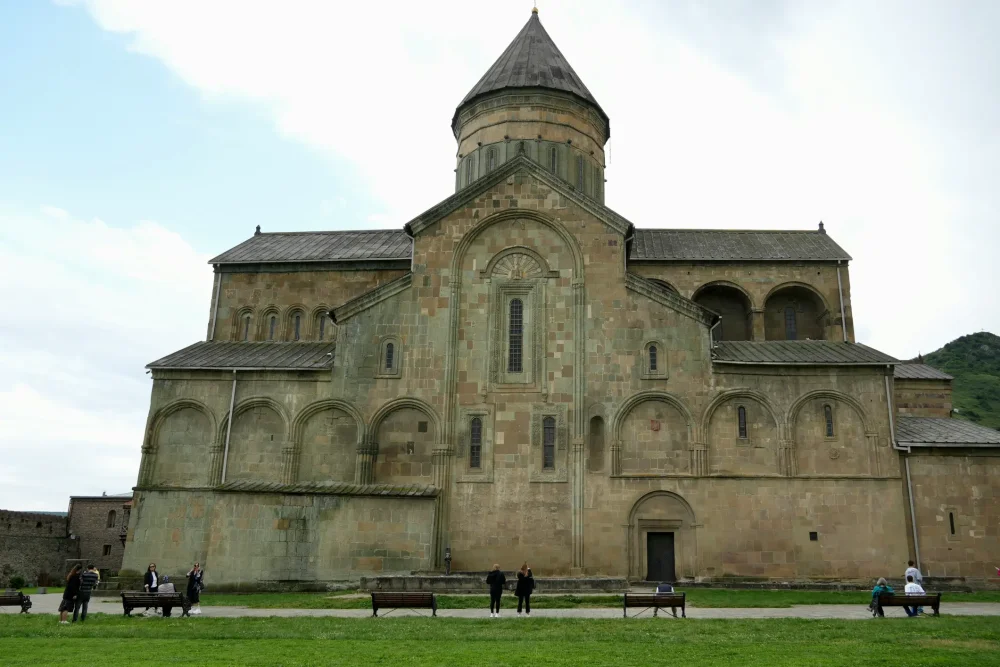
Georgia is a land where history blends seamlessly with myth, and nowhere is this more tangible than in the ancient city of Mtskheta. Standing proudly at the confluence of the Mtkvari and Aragvi rivers, Svetitskhoveli Cathedral is not just an architectural masterpiece — it is the spiritual cradle of the Georgian nation.
As the largest surviving historical church in Georgia, this UNESCO World Heritage site has guarded the country’s deepest secrets, grandest triumphs, and most sacred relics for a millennium.
What Makes Svetitskhoveli So Special?
Svetitskhoveli is universally recognized as one of the most structurally complex and visually stunning examples of medieval Georgian architecture. While the passage of time has erased the names of many ancient builders across the region, Svetitskhoveli is a rare exception.
Thanks to a well-preserved inscription carved into the cathedral’s western façade, history remembers its creators. The majestic building we see today was commissioned in the early 11th century by Catholicos-Patriarch Melchizedek I (who led the church from 1010 to 1033) and brought to life by the genius of the chief architect, Arsukidze.
Beyond its artistic genius, the cathedral holds a status of supreme spiritual importance: it has remained the primary seat of worship for the Georgian Orthodox community since its very foundation.
A Journey Through the Centuries: The Historical Past
The sacred ground beneath Svetitskhoveli has seen the entire evolution of Georgian Christianity:
-
The 4th Century Origins: In the 330s AD, following Georgia’s conversion to Christianity, King Mirian III commissioned the construction of the nation’s very first wooden church. He chose Mtskheta, the ancient and heavily fortified capital of the early Georgian Kingdom of Iberia.
-
The 11th Century Golden Age: Between 1010 and 1029, the wooden structures and earlier stone basilicas were replaced. Arsukidze engineered a grand cross-domed cathedral that perfectly captured the ambition and artistic renaissance of Georgia's Golden Age.
-
A Living Reliquary: The cathedral’s global significance is elevated by the fact that it is believed to be the final resting place of one of the most coveted relics in all of Christendom — Christ’s Robe (or Mantle), brought to Mtskheta by Georgian Jews shortly after the crucifixion.
The Legend of the Life-Giving Pillar
The name "Svetitskhoveli" itself translates to "The Life-Giving Pillar," a title deeply rooted in a miraculous 4th-century legend.
According to ancient accounts, after Christ’s Robe was buried in Mtskheta, a massive, majestic Lebanese cedar grew on that exact spot. When King Mirian and St. Nino (the reappointed evangelist of Georgia) began building the first church, they chopped down the cedar to fashion seven heavy pillars for the foundation.
However, the seventh and grandest pillar possessed a will of its own. It miraculously rose into the sky, hovering high above the ground and defying the builders. It was only after St. Nino spent an entire night in fervent prayer that the pillar slowly descended back to earth. Upon touching the ground, a sacred, healing myrrh began to ooze from the wood, curing the sick and giving the cathedral its legendary name.
💡 The Architect’s Curse: A Forbidden Legend
If you look closely at the northern façade of the cathedral, you will spot a relief carving of a human hand holding a chisel. Local folklore suggests that the architect Arsukidze created something so beautiful that his envious master (or the king, in some versions) ordered his right hand to be severed so he could never replicate or surpass his masterpiece.
Essential Visiting Info for Travelers
If you are planning to add Svetitskhoveli to your travel itinerary, here is what you need to know to make the most of your visit:
-
Location & Accessibility: Located in the heart of Mtskheta, it is an easy 30-minute drive (about 25 km) north of the modern capital, Tbilisi. Minibuses (marshrutkas) run regularly from the Didube station.
-
Dress Code: As an active place of worship, strict respect is required. Men should wear long pants. Women must cover their heads with a scarf and wear skirts (wraparound skirts and scarves are usually available at the entrance for free).
-
Best Time to Visit: Early morning or late afternoon offers the most dramatic lighting on the sandstone exterior, and you will easily beat the midday tour buses.
Svetitskhoveli is more than just an ancient monument; it is a living chronicle of faith, art, and survival. Walking beneath its soaring dome offers a profound glimpse into the true soul of Georgia.


Comments